
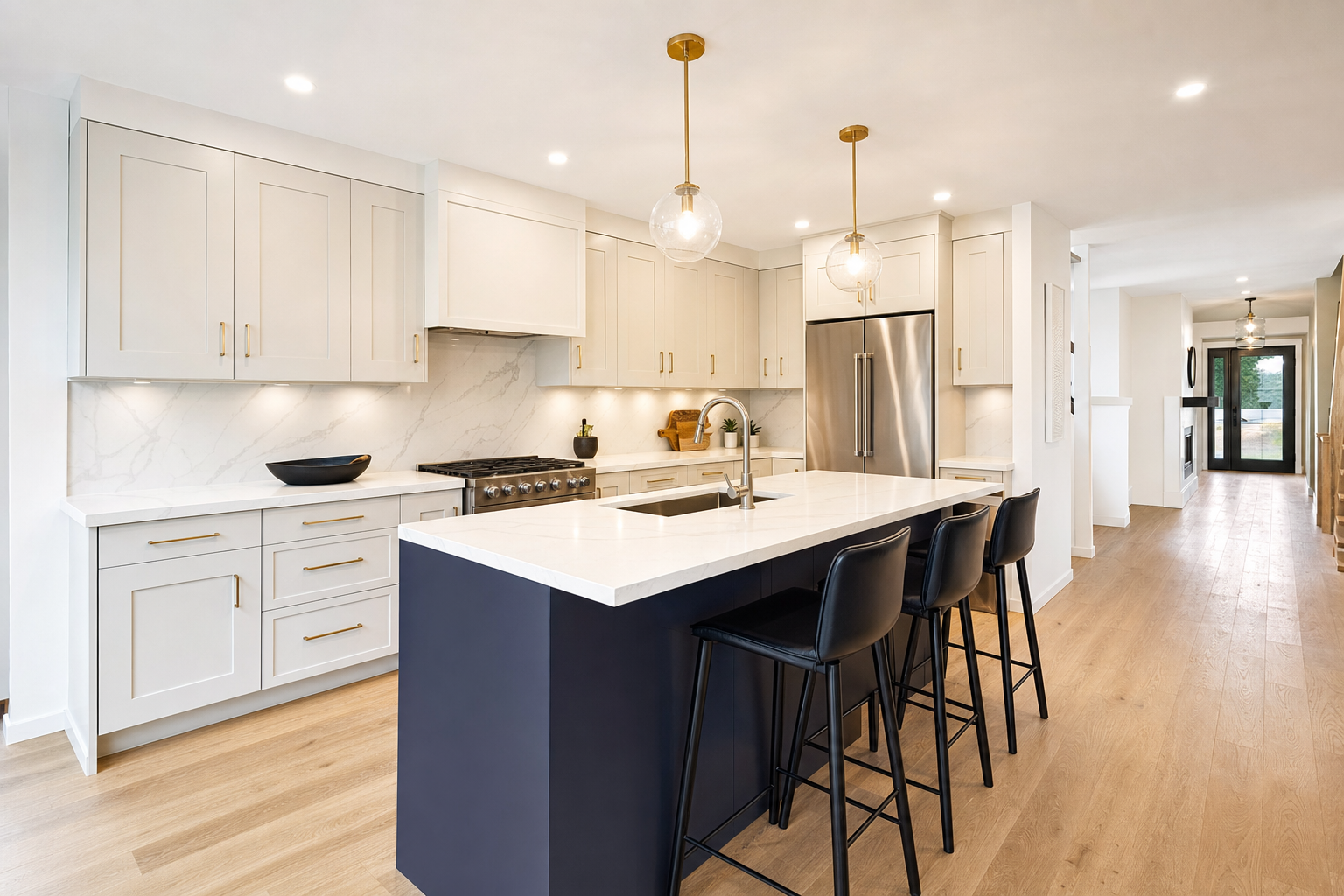
What Is The Average Cost For A Kitchen Renovation in 2026? (GTA Pricing Guide)
Last month, a homeowner from Vaughan called us in a panic. She had budgeted $25,000 for her kitchen renovation based on a design show she watched, only to discover three quotes later that her mid-sized kitchen would cost closer to $50,000. This scenario plays out constantly across the Greater Toronto Area. The average cost for a kitchen renovation in the GTA ranges from $30,000 to $80,000 for most projects, with luxury renovations easily exceeding $100,000. But these numbers mean nothing without context: your actual cost depends on size, layout changes, material selections, and whether you’re keeping the existing footprint or moving plumbing and electrical.
After completing over 300 kitchen renovations across Toronto, Richmond Hill, Mississauga, and Thornhill, we’ve learned that most homeowners drastically underestimate costs or get blindsided by hidden expenses. The GTA market presents unique challenges: higher labor costs than other Canadian cities, strict permit requirements under the Ontario Building Code, and material costs that fluctuate based on supply chain issues affecting Canadian distributors. Understanding what drives kitchen renovation costs helps you budget realistically, avoid contractor surprises, and make informed decisions about where to spend and where to save.
Breaking Down Kitchen Renovation Costs By Project Scope
Not all kitchen renovations cost the same because not all projects involve the same scope of work. The industry categorizes kitchen remodels into three tiers, each with dramatically different price points and timelines.
Minor Kitchen Refresh ($15,000 to $30,000): This level involves cosmetic updates without touching the layout. You’re painting or refacing existing cabinets, replacing countertops, updating the backsplash, installing new lighting fixtures, and putting in new appliances. The plumbing and electrical systems stay where they are. No walls move. No permits required in most cases. Timeline runs 2 to 4 weeks. This approach works when your layout functions well but the aesthetics feel dated. We completed a project in Thornhill last year where the homeowner spent $22,000 to transform a 1990s oak kitchen into a modern space with painted cabinets, quartz counters, and updated hardware. The bones were good, so we focused the budget on high-impact visual changes.
Mid-Range Kitchen Renovation ($30,000 to $60,000): This represents the most common kitchen renovation in the GTA. You’re replacing cabinets entirely, installing new countertops, adding or relocating one or two electrical circuits, potentially moving a sink or adding a kitchen island, upgrading to quality appliances, installing new flooring, and updating lighting throughout. Some minor structural work might be involved, like removing a non-load-bearing wall to open the space to the dining area. Permits are typically required for electrical and plumbing changes. Timeline extends to 6 to 10 weeks depending on material lead times and inspection schedules. At Reformo, about 60% of our kitchen projects fall into this category. Homeowners want a completely new kitchen but aren’t chasing ultra-premium finishes or complex architectural changes.
High-End Custom Kitchen ($60,000 to $150,000+): These projects involve custom cabinetry built to exact specifications, premium materials like marble or exotic wood, moving major plumbing lines or gas connections, significant electrical work including dedicated circuits for professional-grade appliances, structural modifications such as removing load-bearing walls or adding support beams, high-end integrated appliances, custom millwork and built-ins, specialized lighting design with dimmers and task lighting, and premium flooring like wide-plank hardwood or large-format tile. Permits are mandatory and inspection points multiply. Timeline stretches to 10 to 16 weeks or longer if custom elements require extended fabrication. We’ve worked on kitchens in North Toronto where homeowners invested $120,000 to create chef-grade cooking spaces with commercial ventilation, double islands, and appliances that rival restaurant equipment.
The Real Cost Drivers in GTA Kitchen Renovations
Understanding where your money goes helps you control costs and make strategic decisions. Kitchen renovation pricing isn’t arbitrary. Specific elements account for the bulk of your budget.
Cabinetry (30% to 40% of total budget): Cabinets represent the single largest expense in most kitchen renovations. Stock cabinets from big-box stores start around $3,000 for a small kitchen but offer limited sizes and finishes. Semi-custom cabinets, which allow some modifications to dimensions and more finish options, run $8,000 to $20,000 for an average kitchen. Fully custom cabinets built by local millworkers range from $20,000 to $50,000 or more depending on materials, finish quality, and special features like soft-close drawers, pull-out organizers, or integrated appliance panels. Cabinet quality matters enormously for longevity. We’ve seen $5,000 stock cabinets start sagging within five years while properly built custom units remain solid after 20 years.
Countertops (10% to 15% of budget): Material selection drives cost dramatically. Laminate counters cost $30 to $50 per square foot installed, making them the most economical choice but offering limited durability and resale appeal. Quartz countertops, currently the most popular choice in Toronto renovations, run $70 to $120 per square foot installed. They offer durability, low maintenance, and consistent appearance. Granite costs $60 to $100 per square foot but requires periodic sealing. Marble runs $100 to $200 per square foot and demands careful maintenance. Butcher block costs $50 to $80 per square foot and adds warmth but scratches easily. For a typical 40-square-foot counter area, you’re looking at $2,800 to $8,000 depending on material choice.
Labor and Installation (20% to 35% of budget): GTA labor rates run higher than most Canadian markets. A licensed general contractor typically charges $75 to $150 per hour depending on the trade and complexity. Demolition costs $1,000 to $3,000 for an average kitchen. Cabinet installation runs $2,000 to $5,000. Electrical work for new circuits, outlets, and lighting costs $1,500 to $4,000. Plumbing modifications range from $800 for simple fixture swaps to $3,000+ for relocating sinks or adding gas lines. Drywall repair and painting add $1,500 to $3,000. Flooring installation varies wildly: $800 for vinyl plank in a small kitchen to $4,000 for tile in a larger space. These costs assume licensed, insured contractors who pull proper permits and follow Ontario Building Code requirements.
Appliances (10% to 20% of budget): A basic appliance package (refrigerator, stove, dishwasher, microwave) from mid-range brands costs $3,500 to $6,000. Upgrading to stainless steel finishes and better features pushes this to $6,000 to $10,000. Professional-grade or integrated appliances run $15,000 to $30,000 or more. Many homeowners underestimate appliance costs or don’t factor in installation fees, which can add $500 to $1,500 depending on whether you need new electrical circuits, gas line modifications, or custom panels for integrated units.
Hidden Costs That Ambush Budgets: Permits in Toronto and surrounding municipalities cost $300 to $1,200 depending on scope. Structural issues discovered during demolition (rotten subfloors, outdated wiring, plumbing problems) add $1,000 to $5,000 in unplanned expenses. Temporary kitchen setup costs often get overlooked: you’ll need a makeshift cooking area for 6 to 12 weeks. Eating out frequently inflates household spending. Design fees for complex projects run $1,500 to $5,000. Storage or disposal for existing cabinets and appliances costs $500 to $1,000. These seemingly minor items add $3,000 to $8,000 to your bottom line if you don’t plan for them.
How Kitchen Size and Layout Changes Impact Your Budget
Square footage directly affects material quantities and labor hours. But layout modifications create exponential cost increases that surprise homeowners who assume adding a few feet won’t matter much.
A small kitchen under 70 square feet (roughly 8×8 or a galley layout) with minimal changes costs $20,000 to $40,000 for a complete renovation. You’re working with limited cabinet space, smaller countertop area, and condensed work zones. Medium kitchens from 100 to 150 square feet (roughly 10×12 to 12×14) represent the average Toronto home kitchen and cost $35,000 to $65,000 for full renovations. Large kitchens over 200 square feet (often open-concept spaces connected to dining or family rooms) run $60,000 to $100,000+ due to increased materials, extended labor hours, and typically higher-end finishes that homeowners choose for these showcase spaces.
Layout changes create the real cost jumps. Keeping everything in place (same cabinet locations, appliances in existing spots, no plumbing or gas line moves) minimizes costs. Moving a sink 3 feet costs $800 to $1,500 in plumbing work. Relocating it across the room costs $2,000 to $4,000 because you’re running new supply and drain lines, potentially through walls or under floors. Moving a gas stove requires licensed gas fitters and permit inspections, adding $1,500 to $3,000. Creating an island where none existed costs $3,000 to $8,000 when you factor in electrical circuits for outlets, potential plumbing if adding a sink or dishwasher, and the island cabinetry itself.
Removing walls multiplies complexity and cost. A non-load-bearing wall removal costs $1,000 to $2,500 including disposal, drywall repair, and flooring patch. Removing a load-bearing wall requires structural engineering, support beam installation, permits, and inspections. Count on $5,000 to $15,000 for this work. We completed a kitchen renovation in Mississauga last year where the homeowner wanted to remove a wall between the kitchen and dining room. The wall was load-bearing. Engineering fees, steel beam fabrication and installation, permit costs, and finishing work added $11,000 to a project that would have cost $42,000 with the wall in place.
Material Selection: Where To Spend and Where To Save
Strategic material choices let you control costs without compromising quality or longevity. Not every element deserves premium investment.
Worth The Investment: Cabinet construction quality matters more than fancy finishes. Solid plywood boxes with dovetail drawers and quality hardware last decades. Cheap particleboard cabinets with stapled corners fail within years. Spend here. Countertop material in work zones (prep areas, sink surrounds) takes constant abuse. Quartz or granite makes sense for these high-use surfaces. Quality faucets and sinks withstand daily use better than budget alternatives. A $400 faucet lasts 15 years while a $80 version fails in 3 years. Quality underlayment and proper subfloor preparation prevent flooring failures regardless of the surface material you choose.
Safe Places To Save: Backsplash material offers huge flexibility. Subway tile at $8 per square foot delivers classic appeal for a fraction of the cost of designer tile at $35 per square foot. Cabinet hardware (handles and knobs) can start basic and upgrade later for under $200. Lighting fixtures offer good savings potential: attractive options exist at every price point, and installation costs stay consistent whether the fixture costs $80 or $400. Paint-grade cabinet doors (designed to be painted rather than stained) cost less than stain-grade and look identical once finished. Appliance packages during holiday sales can save $1,000 to $2,000 compared to regular pricing.
The Mix Strategy: Most successful renovations blend investment and value choices. Use custom cabinets for the main kitchen but stock cabinets for the pantry. Install quartz on the island and food-prep areas but use butcher block or laminate on secondary counters. Choose a statement tile for a small backsplash accent area and subway tile for the larger field. This approach maintains visual impact while controlling total costs. A client in Richmond Hill used this strategy to create a $48,000 kitchen that looked like it cost $70,000 by splurging on a stunning range hood and waterfall-edge island while choosing semi-custom cabinets and mid-range appliances elsewhere.
DIY vs. Professional Installation: The True Cost Comparison
Homeowners frequently assume DIY saves thousands. Sometimes it does. Often it creates expensive problems that cost more to fix than hiring professionals initially.
Tasks suited for capable DIYers include demolition (removing old cabinets, counters, and appliances saves $1,500 to $3,000), painting walls and cabinets (saves $1,000 to $2,500), installing backsplash tile if you have tiling experience (saves $800 to $2,000), and installing cabinet hardware (saves $200 to $500). These tasks require time and effort but limited specialized skills. Mistakes cause minor problems easily fixed.
Tasks requiring licensed professionals include all electrical work beyond replacing existing light fixtures (Ontario Building Code requires licensed electricians for new circuits, outlets, and major changes, and insurance claims can be denied for unlicensed electrical work), plumbing modifications beyond simple fixture swaps (improper work causes leaks that create thousands in water damage), gas line work (requires licensed gas fitters and mandatory inspections), structural modifications (requires engineering and permits), and cabinet installation in many cases (uneven installation causes doors to hang poorly, drawers to stick, and countertops to crack).
The hidden costs of DIY often erase savings. A homeowner who spent three weekends installing cabinets slightly out of level discovered the granite fabricator couldn’t create countertops to hide the errors. Fixing the cabinet installation and reordering counters cost $4,500 on top of his time investment. Electrical work done by a handy friend failed inspection, requiring complete rewiring by a licensed electrician at 1.5 times the original quote. Improperly installed tile backsplash started falling off after six months, requiring professional removal and reinstallation.
The hybrid approach works well: hire professional contractors for skilled trades (electrical, plumbing, gas, structural, cabinet installation, countertop fabrication) and handle demo, painting, and finishing touches yourself. This protects quality and code compliance while saving $3,000 to $7,000 on a typical renovation.
Financing Your Kitchen Renovation and Getting Maximum Value
Few homeowners have $50,000 sitting in a savings account waiting for a kitchen renovation. Understanding financing options and return on investment helps make smart decisions.
Home equity lines of credit (HELOCs) offer the lowest interest rates, typically prime plus 0.5% to 1%. You’re borrowing against your home’s value. For a $50,000 renovation at 6% over 10 years, you’ll pay roughly $555 monthly. Total interest costs around $16,600. HELOCs work well for larger renovations where interest savings offset setup costs. Personal lines of credit or loans carry higher rates (8% to 12%) but require less paperwork and no home appraisal. A $30,000 renovation loan at 10% over 7 years costs about $495 monthly with $11,600 in interest charges. Some banks offer renovation-specific mortgages for major projects. Credit cards make sense only for small portions you can pay off quickly due to high interest rates (19% to 22%).
Kitchen renovations typically return 60% to 80% of their cost in increased home value according to Toronto real estate data. A $60,000 kitchen renovation might add $40,000 to $50,000 in home value. But ROI varies dramatically based on your neighborhood and how your renovation compares to surrounding homes. Bringing a dated kitchen up to neighborhood standards generates better returns than creating the fanciest kitchen on the block. A $100,000 ultra-luxury kitchen in a neighborhood of $800,000 homes won’t return full value because buyers won’t pay $900,000 for that house regardless of the kitchen. The same kitchen in a $1.5 million neighborhood makes financial sense.
Beyond resale value, calculate your personal ROI. If you plan to stay in your home 10+ years, divide the renovation cost by years of use. A $50,000 kitchen used for 15 years costs $3,333 annually, or $278 monthly. For many families, having a functional, attractive kitchen they enjoy daily justifies this cost even without perfect financial returns. The family who cooks together nightly in their renovated kitchen gains value that appraisals don’t capture.
Timing, Permits, and Project Management in the GTA
When you start your renovation and how you manage the project affects both cost and stress levels. Timing matters more than most homeowners realize.
Spring and early summer represent peak renovation season in the GTA. Contractors get booked 6 to 10 weeks out. Material suppliers face higher demand, sometimes causing delays. Some trades charge premium rates during busy season. Fall offers advantages: contractors have more availability, you can negotiate better rates, material deliveries arrive faster, and you’ll have your new kitchen ready for holiday entertaining. Winter creates challenges: some contractors offer discounts to fill schedules, but supply delays from weather-related shipping problems can extend timelines.
Permit timelines affect project scheduling. Toronto building permits currently take 3 to 6 weeks for approval depending on complexity and department backlog. Vaughan, Richmond Hill, and Mississauga run similar timelines. Electrical permits process faster (1 to 2 weeks) but require inspection at rough-in stage before covering walls and final inspection before occupancy. Plumbing permits follow similar patterns. Smart contractors submit permits early and schedule inspections proactively to avoid delays. We’ve seen projects extend 3 to 4 weeks because inspections weren’t booked properly, and inspectors couldn’t come until the following week.
Lead times for materials create the biggest schedule wildcards. Stock cabinets arrive in 1 to 3 weeks. Semi-custom cabinets take 6 to 10 weeks. Custom cabinets require 10 to 16 weeks from order to delivery. Countertop fabrication takes 2 to 4 weeks after template measurement, which can’t happen until cabinets are installed. Appliances in stock arrive within days, but special orders or backorders can delay projects by weeks or months. Tile, flooring, and lighting usually arrive quickly if you choose in-stock options.
A realistic kitchen renovation timeline breaks down like this: design and material selection (2 to 4 weeks), permit submission and approval (2 to 6 weeks), ordering long-lead items like cabinets (happens during permit wait), demolition (2 to 3 days), rough electrical and plumbing (3 to 5 days), inspection (scheduled within 1 week), cabinet installation (3 to 5 days), countertop template (1 day, then 2 to 4 week wait for fabrication), countertop installation (1 day), backsplash installation (1 to 2 days), flooring installation (2 to 4 days), appliance installation (1 day), trim work and painting (2 to 3 days), final inspection and cleanup (1 day). Total elapsed time runs 8 to 14 weeks for most mid-range renovations, though the active work time is only about 4 to 6 weeks. The rest is waiting for materials, permits, and fabrication.
Through Reformo Design & Construction, we manage these timelines as part of our full-service project management approach. Material ordering happens at strategic points to minimize storage needs and weather exposure while ensuring items arrive when needed. Inspections get scheduled proactively. Our 15+ years of experience with GTA municipalities means we know each jurisdiction’s quirks and how to expedite approvals. We maintain relationships with reliable suppliers who prioritize our orders and notify us immediately about potential delays.
Choosing The Right Contractor and Avoiding Common Pitfalls
Contractor selection matters more than any other single decision in your renovation. A skilled contractor saves money through efficient work, prevents costly mistakes, and delivers quality that lasts decades. A poor contractor creates nightmares that cost thousands to fix.
Red flags to avoid include contractors who won’t provide proof of WSIB coverage and liability insurance (you’re liable if uninsured workers get hurt on your property), quotes significantly lower than others (underbidding often means cut corners, unlicensed trades, or surprise charges later), contractors pushing you to pay large deposits upfront (30% is standard, 50%+ suggests cash flow problems), unwillingness to put timelines and specifications in writing (verbal promises mean nothing when disputes arise), and contractors who discourage permits for work that requires them (unpermitted work causes insurance and resale problems).
Green flags to seek include licensed contractors who pull proper permits and carry WSIB and liability insurance, detailed written quotes breaking down materials, labor, and timelines, willingness to provide references from recent projects in your area, clear communication about potential problems and how they’ll be handled, experience with your specific renovation type (not all contractors excel at kitchens), and established business locations (not just a cell phone number). At Reformo, we’ve held our Thornhill office at 2305-7165 Yonge St for years, maintaining our reputation through hundreds of completed projects across the GTA.
Contract essentials include total project cost with payment schedule tied to completion milestones, detailed scope of work specifying exactly what’s included and excluded, material specifications listing brands, models, and quality levels, project timeline with start and substantial completion dates, change order process explaining how additional work gets priced and approved, warranty terms covering workmanship and materials, and cleanup and disposal responsibilities. Never start work without a signed contract covering these elements.
Common homeowner mistakes that increase costs include changing design decisions after work begins (change orders typically cost 20% to 40% more than including items initially), choosing materials before consulting contractors about installation requirements (that beautiful tile might require expensive substrate preparation), failing to plan for temporary living arrangements during renovation (stress-driven decisions waste money), assuming the lowest quote means the best value (it usually means problems), and not budgeting contingency funds (plan for 10% to 20% extra for unforeseen issues).
Frequently Asked Questions About Kitchen Renovation Costs
How much does a kitchen renovation cost in Toronto compared to other Canadian cities?
Toronto and GTA kitchen renovations typically cost 15% to 25% more than comparable projects in cities like Ottawa, Calgary, or Halifax. Labor rates run higher in the GTA, material costs increase due to higher overhead for local suppliers, and permit fees in Toronto proper exceed most other municipalities. A mid-range kitchen costing $45,000 in Toronto might cost $35,000 to $38,000 in a smaller Ontario city. However, home values in Toronto are proportionally higher, so the renovation-to-home-value ratio often remains similar across markets.
Should I renovate my kitchen before selling my house?
Renovate if your kitchen is significantly outdated compared to other homes in your price range and neighborhood. Buyers expect kitchens to match the home’s overall value: a dated 1980s kitchen in a $900,000 home hurts your sale price and time on market more than the same kitchen in a $500,000 home where buyers expect to renovate. Don’t over-renovate beyond your neighborhood standards since you won’t recoup the investment. A strategic $30,000 to $45,000 renovation that brings your kitchen to current expectations typically returns 70% to 85% of cost in increased sale price while helping your home sell faster. Ultra-luxury renovations rarely return full value unless your home price supports the investment.
What adds the most value in a kitchen renovation?
Updated cabinetry and countertops deliver the highest return because they define the kitchen’s appearance and functionality. After that, modern appliances in stainless or integrated finishes, quality flooring that flows with adjacent rooms, and improved lighting (especially under-cabinet task lighting and updated fixtures) add substantial perceived value. Surprisingly, ultra-premium upgrades like commercial ranges or exotic countertop materials add less value than homeowners expect. Most buyers appreciate good quality and current style more than luxury finishes. Focus your budget on elements that improve function, increase storage, and create a cohesive modern aesthetic rather than chasing the most expensive materials.
How much should I budget for unexpected costs during a kitchen renovation?
Set aside 15% to 20% of your total budget for contingencies. Older homes often reveal surprises during demolition: outdated wiring that needs upgrading, water damage around sinks, uneven floors requiring leveling, or plumbing that doesn’t meet current code. Even in newer homes, unforeseen issues arise: special-order materials arriving damaged requiring reorder and delay costs, design changes once you see the space opened up, or upgraded finishes once you see samples in your actual lighting. Having $7,500 to $10,000 contingency on a $50,000 renovation prevents panic when issues emerge. If you don’t use the contingency, consider that money available for upgrades or simply saved. But don’t start without it.
Can I live in my house during a kitchen renovation?
Yes, though expect significant disruption for 6 to 12 weeks. Set up a temporary kitchen in another room with a microwave, toaster oven, electric kettle, and mini-fridge. Stock paper plates and disposable utensils. Plan simple meals or budget for increased takeout costs (typically $500 to $1,200 more than normal for a family during the renovation). Dust travels throughout the house despite plastic barriers, so seal rooms you want protected. Noise starts early (contractors often begin at 7:00 or 8:00 AM) and continues all day. Strangers are in your home daily. Bathrooms get used by workers. For some families, staying with relatives for the roughest 3 to 4 weeks preserves sanity. Others manage fine with realistic expectations. Just don’t underestimate the inconvenience, especially with young children at home.
Start Your Kitchen Renovation With Confidence
Understanding the average cost for a kitchen renovation in the GTA equips you to budget realistically, make strategic choices, and avoid the financial surprises that derail projects. Whether you’re investing $30,000 in a focused update or $80,000 in a complete transformation, success comes from clear priorities, quality contractors, and thorough planning. Your kitchen renovation represents one of the largest investments you’ll make in your home. Approach it with the research and preparation it deserves.
Reformo Design & Construction has delivered hundreds of successful kitchen renovations across Toronto, Thornhill, Richmond Hill, Vaughan, and throughout the Greater Toronto Area. Our certified team brings 15+ years of experience, transparent pricing, and full-service project management from initial design through final cleanup. We handle permits, manage timelines, coordinate trades, and deliver Canadian-standard quality on schedule and on budget. Ready to discuss your kitchen renovation? Get your free detailed quote today, or call us at (416) 848-6769 to speak with our renovation specialists about bringing your kitchen vision to life.