
What Is the Average Cost to Renovate a Bathroom in the GTA?
A homeowner in Thornhill recently called us with a simple question: “I have $8,000. Can I renovate my bathroom?” The honest answer surprised them. It depends entirely on what they mean by “renovate.” Are we talking about replacing a vanity and toilet, or gutting everything down to the studs? The average cost to renovate a bathroom in the Greater Toronto Area ranges from $8,000 for a basic refresh to $35,000+ for a complete overhaul, but those numbers tell only half the story. What really determines your final invoice is the scope of work, material choices, and how many surprises hide behind your walls. After completing hundreds of bathroom renovation projects across Toronto, Vaughan, and Mississauga, we have seen every scenario imaginable: the $12,000 budget that turned into $18,000 after discovering rotted subfloor, the $25,000 spa bathroom that came in under budget, and everything in between. This guide breaks down real costs based on actual GTA projects.
Understanding the Three Tiers of Bathroom Renovation Costs
Not all bathroom renovations cost the same, and understanding the different levels helps you set realistic expectations before meeting with contractors. The renovation industry typically recognizes three distinct tiers, each with different outcomes and price points.
A basic refresh runs between $8,000 and $15,000. This level keeps your existing layout intact. You are replacing fixtures, updating the vanity, installing new flooring, and giving walls a fresh coat of paint or new tile. The plumbing stays where it is. The electrical outlets do not move. You work within the footprint you already have. This approach makes sense for rental properties, quick updates before selling, or situations where the bathroom layout functions well but looks dated.
Mid-range renovations fall between $15,000 and $28,000. Here you are making meaningful changes. Maybe you are relocating the toilet to create more space, upgrading to a walk-in shower from a tub-shower combo, or adding heated floors. The scope includes all new fixtures, quality tile work, improved lighting, proper ventilation, and attention to details like recessed medicine cabinets or custom storage. Most GTA homeowners who want a bathroom that feels modern and functions better land in this range.
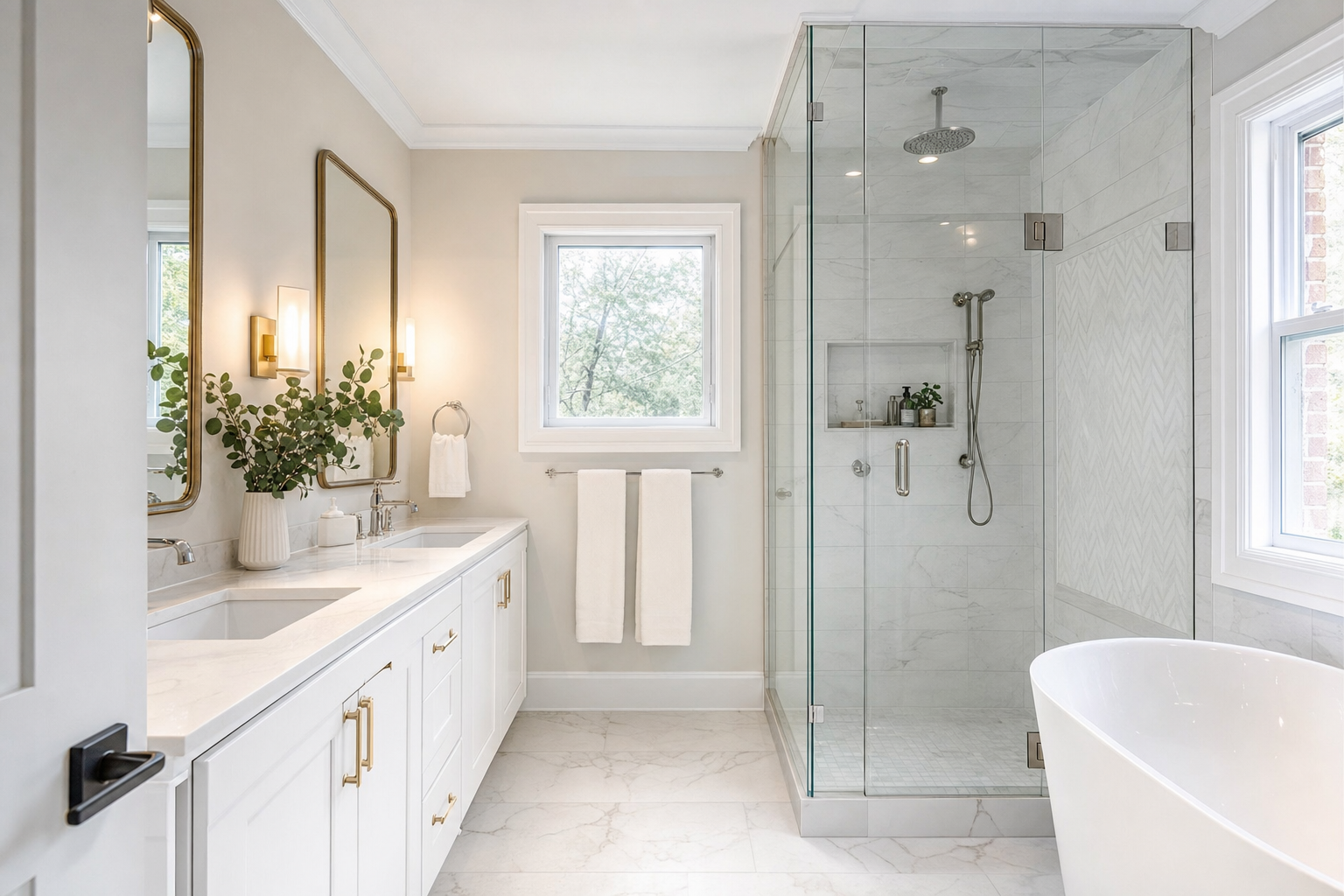
High-end luxury renovations start at $28,000 and easily exceed $50,000 for larger primary bathrooms. You are talking about complete spatial redesigns, premium materials like natural stone or porcelain slabs, custom millwork, high-end fixtures from European manufacturers, radiant heating systems, steam showers, smart toilets, and architectural details that transform the space. These projects often involve structural modifications, moving walls, or expanding into adjacent spaces.
Breaking Down the Cost Components in a Typical GTA Bathroom Renovation
Understanding where your money actually goes helps you make informed decisions about where to invest and where to save. Let me walk you through a typical $20,000 bathroom renovation for a standard 5×8 foot bathroom in Toronto.
Labor typically consumes 40-50% of your budget, roughly $8,000-$10,000 in this scenario. This covers the general contractor’s project management, demolition and site preparation, tile installation, plumbing work in Toronto and the GTA, electrical updates, drywall, painting, and final cleanup. The tile setter alone might account for $3,000-$4,000 of this total because quality tile installation requires skill and time. Rushing this phase creates problems that haunt you for years.
Fixtures and fittings take another 20-25% of the budget, about $4,000-$5,000. This category includes your toilet, vanity and sink, faucets, shower valve and showerhead, bathtub if applicable, mirrors, lighting fixtures, exhaust fan, towel bars, and toilet paper holder. The range here is enormous. A basic toilet costs $200. A wall-hung Duravit with soft-close seat runs $1,200. A builder-grade vanity with cultured marble top costs $600. A custom vanity with quartz countertop and undermount sink starts at $2,500.
Materials for surfaces represent 15-20% of costs, roughly $3,000-$4,000. This covers tile for floors and walls, backing materials like cement board or waterproofing membrane, grout and setting materials, flooring underlayment, paint, trim, and miscellaneous supplies. Tile choices dramatically impact this category. Basic ceramic subway tile costs $3-$5 per square foot. Large-format porcelain or natural stone runs $8-$15 per square foot, and that is before installation.
Permits, disposal, and contingency account for the remaining 10-15%, about $2,000-$3,000. Toronto and surrounding municipalities require building permits for bathroom renovations that involve plumbing or structural changes. Permit costs vary by municipality but typically range from $300-$800. Dumpster rental or waste removal adds $400-$800. The contingency covers unexpected issues like water damage, outdated wiring that needs upgrading to meet current Ontario Building Code requirements, or structural surprises.
Hidden Costs That Catch GTA Homeowners Off Guard
The gap between estimated costs and final invoices often comes down to hidden issues and scope creep. After 15+ years managing renovation projects across the Greater Toronto Area, certain surprises appear more frequently than others.
Water damage behind walls happens in roughly 30% of bathroom renovations, especially in homes built before 1990. Once the old tile or shower surround comes off, you discover rotted drywall, compromised studs, or even mold. Remediation and rebuilding can add $1,500-$4,000 to your budget. Older homes in Toronto neighborhoods like North York, Scarborough, or Etobicoke frequently have this issue because older waterproofing methods were less effective.
Plumbing updates become necessary when existing pipes do not meet current code or show signs of failure. Cast iron drain pipes common in pre-1970s homes often need replacement. Galvanized supply lines should be replaced with copper or PEX. Moving any plumbing fixture requires new rough-in work. Budget an extra $1,000-$3,000 for significant plumbing modifications beyond simple fixture swaps.
Electrical system upgrades catch people by surprise. Bathrooms now require GFCI protection, dedicated circuits for certain fixtures, proper ventilation wired to humidity sensors, and adequate lighting. If your electrical panel is outdated or lacks capacity, upgrades become necessary. This can add $800-$2,500 depending on the scope.
Ventilation requirements under Ontario Building Code mandate proper exhaust fans in bathrooms. Many older homes have inadequate or non-existent ventilation. Installing a quality fan with proper ducting to the exterior costs $400-$800. Cutting through exterior walls or routing ductwork through complicated paths increases costs.
Flooring beyond the bathroom often needs attention. When you replace bathroom flooring, it rarely matches existing hallway flooring perfectly. Many homeowners end up extending new flooring into the hallway for a seamless transition, adding $500-$1,500 to the project.
Design changes mid-project are the most controllable hidden cost. You see a nicer tile in the showroom. You decide the chosen vanity looks too small. These decisions add up quickly. We encourage clients to make all selections before demolition begins to avoid expensive change orders.
How Size and Layout Changes Impact Your Bathroom Renovation Budget
Bathroom size directly affects material quantities and labor hours, but layout complexity matters more than square footage. A 40-square-foot powder room with intricate tile work and high-end fixtures can cost as much as a basic 100-square-foot primary bathroom.
Small powder rooms (15-25 square feet) typically cost $8,000-$15,000 for a complete renovation. Less square footage means less tile, smaller vanities, and reduced labor hours. However, tight spaces create installation challenges. Maneuvering materials, working in confined areas, and achieving proper waterproofing in compact spaces requires extra care.
Standard full bathrooms (35-50 square feet) represent the sweet spot for renovation value, typically costing $12,000-$25,000. This size accommodates a tub or shower, toilet, and vanity with enough room for comfortable movement. Most GTA homes have at least one bathroom in this size range.
Large primary bathrooms (75-150 square feet) start at $20,000 and easily exceed $45,000. More space means more tile, larger vanities (often double sinks), separate shower and tub, and additional lighting and ventilation. However, you gain design flexibility and can incorporate luxury features like freestanding tubs, walk-in showers with multiple shower heads, and custom storage solutions.
Layout changes add significant costs regardless of size. Moving a toilet requires relocating the drain line, often the most expensive plumbing modification. Depending on whether you are moving it a few feet or across the room, and whether you have basement access or a concrete slab foundation, costs range from $800 to $3,500. Moving the shower or tub involves similar complexity. Relocating the vanity is typically the least expensive layout change because supply lines are easier to run than drain lines.
Expanding a bathroom into adjacent space requires structural work like removing walls, potentially relocating doors, extending flooring into the new space, and dealing with HVAC adjustments. A modest expansion of 20-30 square feet can add $5,000-$12,000 to your project before you even start the bathroom-specific work.
Material Choices That Make or Break Your Budget
Material selection creates the widest cost variance in bathroom renovations. Two identical 5×8 bathrooms can cost $12,000 or $32,000 based purely on finishes and fixtures. Understanding your options helps you allocate budget strategically.
Tile selection impacts both material and labor costs. Ceramic tile, the most budget-friendly option, costs $3-$7 per square foot for materials. Porcelain tile, more durable and water-resistant, runs $5-$12 per square foot. Natural stone like marble or granite ranges from $10-$30 per square foot. Large-format tiles (24×48 inches or larger) cost more per square foot and require more expensive installation, but create fewer grout lines and a more modern aesthetic. Installation labor varies from $8-$15 per square foot for basic patterns to $18-$30 per square foot for complex layouts, herringbone patterns, or intricate mosaics.
Vanity options span an incredible range. A basic 36-inch vanity with integrated top from a big box store costs $400-$800. A semi-custom vanity with quality construction and stone countertop runs $1,200-$2,500. Custom millwork designed specifically for your space starts at $3,000 and can exceed $8,000 for elaborate designs with specialized storage, premium wood species, and high-end hardware. Countertop material adds another variable: laminate costs $50-$100, cultured marble runs $100-$200, quartz ranges from $300-$800, and natural stone can exceed $1,000 for a vanity-sized piece.
Shower and tub fixtures create another decision point. A basic acrylic tub costs $300-$600. A quality cast iron or acrylic soaking tub runs $800-$1,800. Freestanding designer tubs start at $2,000 and can exceed $6,000. For showers, a fiberglass surround costs $300-$600, while custom tile work with quality waterproofing runs $2,500-$6,000 depending on size and complexity. Shower valves and fixtures range from $200 for basic chrome sets to $1,500+ for thermostatic valves with multiple body sprays.
Flooring choices beyond tile include vinyl plank ($3-$6 per square foot), which has improved dramatically in quality and appearance, offering excellent water resistance at a lower price point. Heated floor systems add $15-$25 per square foot but transform the bathroom experience, especially valuable in Canadian winters.
Lighting and ventilation often get shortchanged in budget planning but dramatically affect functionality. Basic bathroom fans cost $80-$200, while quality units with humidity sensors and quiet operation run $200-$500. Proper lighting requires multiple layers: ambient lighting, task lighting at the vanity, and accent lighting if desired. Budget $400-$1,200 for a complete lighting package that actually works.
DIY vs. Professional Renovation: The Real Cost Comparison
Many GTA homeowners consider tackling bathroom renovations themselves to save money. The potential savings are real, but so are the risks. Let me break down what you are actually getting into.
A competent DIYer with proper tools and genuine skills can save 40-50% on labor costs for certain tasks. If you are comfortable with tile installation, can handle basic plumbing, and have experience with finish carpentry, you might reduce a $20,000 professional renovation to $12,000-$14,000 doing portions yourself. The key phrase is “competent DIYer with proper tools.”
The reality we see in the GTA renovation market: most DIY bathroom projects take 3-5 times longer than anticipated and often require professional correction. A contractor completes a full bathroom renovation in 3-4 weeks. DIY projects stretch to 3-6 months because homeowners work evenings and weekends, underestimate complexity, and hit snags that stop progress.
Certain tasks should never be DIY projects unless you are licensed and experienced. Plumbing modifications require permits in Toronto and must meet Ontario Building Code requirements. Mistakes create leaks that cause thousands in water damage. Electrical work must be done to code and inspected. Improper waterproofing in showers leads to catastrophic water damage that costs far more to remediate than proper installation would have cost initially.
Tasks suitable for skilled DIYers include demolition (be careful around plumbing and electrical), painting, installing pre-made vanities, replacing toilets and simple fixtures, and potentially some tile work if you have experience and proper tools. Even here, understand that professional demolition crews finish in hours what takes a homeowner a full weekend, and they know how to protect surrounding areas from damage.
The hybrid approach makes sense for many: hire professionals for technical work (plumbing, electrical, tile setting, waterproofing) and handle simpler tasks yourself (demolition, painting, fixture installation). This gives you cost savings without the major risks. A general contractor can coordinate this approach, bringing in specialized trades when needed while you contribute labor on appropriate tasks.
Tool costs often surprise DIYers. Quality tile saws, wet saws, oscillating multi-tools, proper drill bits, levels, and specialized plumbing and electrical tools can easily cost $800-$2,000 to buy or $200-$400 to rent for an extended project. Professional contractors already own these tools and know how to use them efficiently.
How to Get Accurate Quotes and Avoid Contractor Issues in the GTA
The Toronto and GTA renovation market is competitive but also filled with variables in contractor quality, pricing approaches, and communication styles. Getting accurate quotes requires understanding how professional contractors estimate projects and what red flags to watch for.
Detailed quotes beat vague estimates every time. A professional quote should break down labor, materials, permits, and specific line items for each trade involved. When Reformo Design & Construction provides estimates, we itemize plumbing fixture installation separately from tile work, specify tile allowances per square foot, and clearly state what is included versus what might trigger additional charges. Vague quotes like “$18,000 for complete bathroom renovation” leave too much room for disputes about what “complete” actually means.
Material allowances require clear definition. Many contractors quote using allowances: “tile allowance of $6 per square foot” or “vanity allowance of $1,500.” This approach works if the allowance is realistic for your expectations. Problems arise when allowances are artificially low to make the overall quote attractive, then every material you actually like exceeds the allowance. Ask to see examples of materials at the quoted allowance levels before signing any agreement.
Get at least three quotes for comparison, but understand that the lowest bid often signals problems. Contractors who significantly underbid competitors are either inexperienced and don’t understand true costs, cutting corners on quality or code compliance, or planning to make money through change orders and extras. A realistic quote from an experienced, insured contractor falls within a reasonable range of other quality contractors.
Verify credentials before hiring anyone. In Ontario, contractors performing work over $500 should be insured with liability coverage and WSIB clearance. Ask for proof. Check references and actually call them. Visit previous job sites if possible. The contractor should have clear business contact information, not just a cell phone. Our offices at 2305-7165 Yonge St in Thornhill provide a physical location where clients can meet us, review materials, and discuss projects in detail.
Payment schedules matter. Never pay the full amount upfront. Reasonable payment structures involve a deposit (typically 10-25%), progress payments tied to completed milestones, and final payment upon satisfactory completion. Be wary of contractors demanding large cash deposits or full payment before work begins.
Timelines should be realistic and documented in your contract. A complete bathroom renovation typically takes 3-4 weeks once started, though complex projects can extend to 5-6 weeks. Contractors who promise completion in one week are either working on very basic refreshes or overpromising. Weather rarely affects interior renovations, but material delivery delays, permit processing, and inspection scheduling can impact timelines.
Change order procedures need clear documentation. Changes during renovation are common, but they should be documented in writing with adjusted costs before work proceeds. This protects both parties from disputes about what was agreed upon.
Maximizing ROI on Your Bathroom Renovation Investment
Bathroom renovations typically return 60-70% of costs when selling a home in the GTA market, making them one of the better renovation investments. However, return on investment varies significantly based on several factors.
The sweet spot for value is mid-range renovations. Spending $15,000-$25,000 on a full bathroom refresh appeals to the broadest buyer pool. These renovations eliminate buyer concerns about outdated or problematic bathrooms without pushing the home into a higher price bracket that limits potential buyers. Going too basic leaves money on the table. Going ultra-luxury rarely returns full investment unless you are in high-end neighborhoods where buyers expect premium finishes.
Focus spending on elements buyers notice immediately: clean, modern tile work, quality fixtures, good lighting, and functional storage. Homebuyers form impressions in seconds. A beautiful tile shower with frameless glass door creates impact. Hidden luxuries like heated floors or premium insulation behind walls provide satisfaction during ownership but do not translate to proportional resale value.
Functionality upgrades provide real value. Converting a tub-shower combo to a walk-in shower appeals to aging homeowners and modern buyers. Adding a second bathroom to a one-bathroom home returns exceptional value, often 100% or more of renovation costs. Upgrading a cramped primary bathroom to include double sinks instead of a single pedestal dramatically improves daily functionality.
Neutral design choices protect resale value. Your personal love for bold geometric tile or unique color schemes might not match future buyer tastes. Stick with classic subway tiles, neutral grays and whites, and timeless fixtures for the best return. Save bold statements for easily changeable elements like paint colors or accessories.
Quality matters for longevity. Spending an extra $2,000 on proper waterproofing, quality fixtures that last, and skilled tile installation pays off through years of trouble-free use. Cheap renovations that start showing problems within a few years ultimately cost more through repairs and diminished resale value. We see this frequently in the Toronto market when homeowners cut corners on fundamentals to save money upfront.
Timing your renovation affects ROI. If you plan to sell within 1-2 years, a bathroom renovation makes financial sense because you will likely recoup 60-70% of costs in higher sale price. If you plan to stay 5-10 years, ROI calculations become less important than personal enjoyment and functionality. You are buying daily satisfaction, not just resale value.
Frequently Asked Questions About Bathroom Renovation Costs in Toronto and the GTA
How long does a typical bathroom renovation take from start to finish?
A standard full bathroom renovation typically takes 3-4 weeks once work begins. This includes demolition (1-2 days), rough plumbing and electrical updates (2-3 days), inspection if required (1 day for inspector visit), tile installation and waterproofing (5-7 days including drying time), fixture installation (2-3 days), painting and finishing (2-3 days), and final cleanup. More complex projects involving layout changes or structural modifications can extend to 5-6 weeks. The timeline assumes materials are ordered and available before starting. Custom vanities or special-order tiles can add 2-4 weeks to lead times, so advanced planning matters. At Reformo, we provide detailed timelines during project planning so homeowners can prepare for the disruption and plan accordingly.
Do I need building permits for bathroom renovations in Toronto and the GTA?
Yes, building permits are required for most substantial bathroom renovations across Toronto, Vaughan, Richmond Hill, Mississauga, and other GTA municipalities. Any work involving plumbing modifications, electrical changes, structural alterations, or significant renovations requires permits. Simple cosmetic updates like painting, replacing a vanity without moving plumbing, or installing new flooring typically do not require permits. Permit costs vary by municipality but generally range from $300-$800 for bathroom renovations. The permit process typically takes 2-4 weeks for approval, and inspections are required at various stages. Working without required permits creates problems when selling your home and can result in fines or required remediation. Professional contractors handle permit applications and inspections as part of their service, ensuring work meets Ontario Building Code requirements.
What is the most expensive part of a bathroom renovation?
Tile installation consistently ranks as the most expensive single component in bathroom renovations, often consuming 25-30% of the budget when you combine material costs with professional installation labor. A typical 5×8 bathroom might require 100-150 square feet of tile for walls and floors. At $8-$12 per square foot for quality porcelain tile plus $12-$18 per square foot for professional installation, you are looking at $2,000-$4,500 just for tile work. The cost reflects both material prices and the skill required for proper installation. Tile work involves surface preparation, waterproofing, precise layout to minimize awkward cuts, proper setting techniques, grouting, and sealing. Rushed or poorly executed tile work creates water damage that costs far more to repair than proper installation would have cost initially. This is one area where professional expertise pays long-term dividends.
Can I renovate my bathroom for under $10,000 in the GTA?
Yes, but with realistic expectations about scope. A $10,000 budget works for basic refreshes that maintain existing layouts: replacing the toilet, vanity, and fixtures, updating flooring, applying fresh paint or simple tile updates, improving lighting, and ensuring proper ventilation. You will need to shop strategically for materials, accept mid-grade rather than luxury fixtures, and keep the plumbing layout exactly as it exists. DIY contributions on simpler tasks like demolition or painting can stretch the budget further. However, $10,000 typically does not cover complete gut renovations, layout changes, high-end materials, or extensive tile work. Hidden issues like water damage or code-required updates can also consume a $10,000 budget quickly. The key is transparent communication with your contractor about what is actually achievable within budget constraints before demolition begins.
Should I renovate my bathroom before selling my house?
It depends on your bathroom’s current condition and your local market. If your bathroom is dated but functional, you might get better return selling as-is and pricing accordingly. Many GTA buyers prefer choosing their own finishes. However, if your bathroom has obvious problems such as cracked tiles, water damage, outdated 1970s fixtures, or poor functionality, renovation before selling typically pays off. A modest $12,000-$18,000 renovation that brings the bathroom to current standards can add $20,000-$30,000 to sale price and help the home sell faster. The GTA market is competitive, and homes with updated bathrooms stand out in listings. Consult with a real estate professional about your specific neighborhood before committing to pre-sale renovations. They can advise whether your market values updated bathrooms enough to justify the investment and timeline.
Ready to Start Your GTA Bathroom Renovation?
Understanding bathroom renovation costs gives you power in planning, budgeting, and working with contractors. The numbers we have discussed reflect real projects across Toronto, Thornhill, Vaughan, Richmond Hill, and Mississauga over 15+ years of renovation work. Your specific project will have unique variables based on bathroom size, material selections, scope of work, and unforeseen conditions, but now you have realistic expectations for what different budget levels actually deliver.
Reformo Design & Construction specializes in bathroom renovations throughout the Greater Toronto Area, bringing transparent pricing, certified and insured teams, and full-service project management from initial design through final cleanup. We have completed hundreds of bathroom projects and understand how to navigate Ontario Building Code requirements, GTA permit processes, and the specific challenges of renovating in established neighborhoods. Our team at 2305-7165 Yonge St in Thornhill is ready to discuss your bathroom renovation vision, provide detailed cost breakdowns specific to your space, and show you examples from our completed project portfolio. Call us at (416) 848-6769 or request your free detailed quote to transform your bathroom with confidence, clarity, and Canadian-standard quality.