
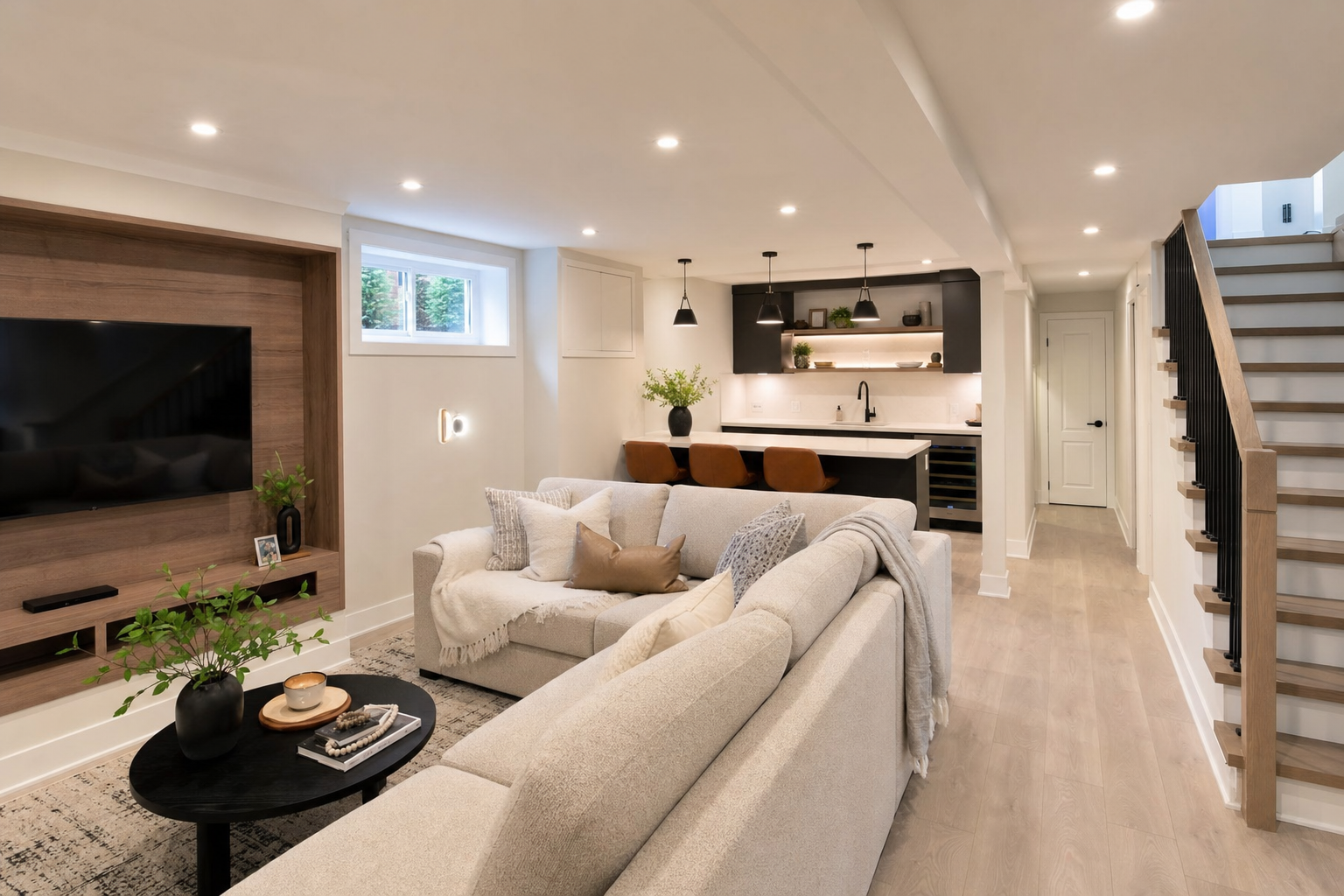
If you’re wondering how much is a basement remodel in the Greater Toronto Area, you’re looking at a project that typically ranges from $40,000 to $120,000 or more depending on size, layout complexity, and finish quality. The average basement renovation in Toronto costs between $75 to $150 per square foot for a complete transformation, with regional variations across the GTA affecting final pricing. This guide breaks down every cost component, regional price differences, and hidden expenses that affect your basement renovation budget across Toronto, Mississauga, Brampton, and surrounding municipalities.
Understanding basement renovation costs requires looking beyond square footage alone. Your final price depends on structural requirements like egress window installations, electrical panel upgrades, plumbing rough-ins, and whether you’re creating legal basement bedrooms that meet Ontario Building Code standards. At Reformo Design & Construction, licensed engineer Mostafa Khorsandnia has overseen hundreds of basement projects across the GTA, and the consistent lesson is that accurate budgeting starts with understanding both visible and hidden cost factors specific to your home and location.
Quick Answer
A basement remodel in the GTA costs $40,000 to $120,000+ depending on size and scope. Expect $75 to $150 per square foot for complete finishing including framing, electrical, plumbing, flooring, and drywall, with Toronto proper trending 10-15% higher than surrounding municipalities.
Average Basement Renovation Costs in the GTA
Basement renovation costs in the Greater Toronto Area reflect both the project scope and local market conditions. You’ll encounter three primary pricing tiers based on finish quality and complexity. A basic renovation with standard finishes runs $75 to $95 per square foot. Mid-range projects with quality materials and some custom features cost $95 to $125 per square foot. High-end basement remodels with premium finishes, custom built-ins, and luxury bathrooms exceed $125 to $150+ per square foot.
These per-square-foot figures assume you’re starting with an unfinished basement that needs complete framing, electrical, plumbing, insulation, drywall, flooring, and finishing. Basement size directly impacts total renovation costs, though larger basements often achieve slightly lower per-square-foot pricing due to fixed costs spreading across more area.
| Basement Size | Basic Renovation | Mid-Range Renovation | High-End Renovation |
|---|---|---|---|
| 400-600 sq ft | $35,000 – $57,000 | $48,000 – $75,000 | $60,000 – $90,000 |
| 600-800 sq ft | $52,500 – $76,000 | $66,500 – $100,000 | $87,500 – $120,000 |
| 800-1000 sq ft | $68,000 – $95,000 | $85,500 – $125,000 | $112,500 – $150,000 |
| 1000-1200 sq ft | $82,500 – $114,000 | $104,500 – $150,000 | $137,500 – $180,000+ |
These ranges assume complete finishing with standard layouts. Adding features like wet bars, home theaters, multiple bathrooms, or separate apartment suites pushes costs toward or beyond the high end. Location matters too. A 700-square-foot basement renovation in downtown Toronto typically costs 10-15% more than the same project in Mississauga or Brampton due to permit fees, parking challenges for contractors, and higher labor rates.
Key Takeaways
- Budget $75-$150 per square foot for complete GTA basement renovations.
- Expect 10-15% higher costs in Toronto versus surrounding municipalities.
- Add 15-20% contingency for structural surprises and permit requirements.
- Include egress windows for legal bedrooms, adding $3,000-$5,000 per window.
- Request itemized quotes separating materials, labor, permits, and design fees.
Complete Cost Breakdown: What Goes Into Your Basement Budget
Understanding how your basement renovation budget distributes across different categories helps you make informed decisions and identify where to invest or economize. Labor costs typically consume 40-50% of your total budget, while materials account for 30-40%. Permits, design fees, and contingencies make up the remaining 10-20%.
Structural and framing work including studs, insulation, vapor barriers, and labor costs $12 to $22 per square foot. Electrical rough-in with wiring, outlets, switches, panels, and fixtures runs $15 to $25 per square foot. Plumbing rough-in for bathrooms costs $5,000 to $9,000 per bathroom including supply lines, drains, venting, and fixtures. HVAC extensions add $2,000 to $8,000 depending on complexity. Drywall installation with taping, mudding, and priming costs $3 to $5 per square foot. Flooring ranges from $4 to $15 per square foot depending on material selection. Interior doors cost $250 to $600 each installed. Painting runs $2 to $4 per square foot. Trim and baseboards add $3 to $8 per linear foot installed.
For a typical 700-square-foot basement with one bathroom, expect structural and framing ($8,400-$15,400), electrical ($10,500-$17,500), plumbing ($5,000-$9,000), HVAC ($3,000-$6,000), drywall ($2,100-$3,500), flooring ($2,800-$10,500), doors and trim ($2,000-$4,000), painting ($1,400-$2,800), permits and design ($3,000-$5,500), and contingency ($5,000-$10,000). This totals $52,200 to $84,200, aligning with the $75-$120 per square foot range.
Finishing vs. Remodeling vs. Renovating: Understanding the Cost Differences
These terms are often used interchangeably, but they describe different project scopes with distinct cost implications. Understanding the differences helps you communicate clearly with contractors and budget appropriately.
Basement finishing refers to transforming an unfinished basement into livable space. You’re starting with concrete walls and floors, exposed joists, and bare utilities. Finishing includes framing walls, installing electrical and plumbing, adding insulation and drywall, installing flooring, and adding fixtures. This represents the most predictable cost scenario at $75-$150 per square foot because you’re building from a blank slate without demolition or removal of existing finishes.
Basement remodeling means changing the layout or function of an already-finished basement. You might be converting a recreation room into a rental suite, adding a bathroom where none existed, or reconfiguring walls. Remodeling costs $80-$160 per square foot because you’re paying for demolition, disposal, and working around or relocating existing systems. Expect 10-20% higher costs than finishing due to demolition labor and unpredictable conditions hidden behind existing walls.
Basement renovating is the broadest term, encompassing both finishing unfinished spaces and updating existing finished basements. Renovation projects range from cosmetic updates like new flooring and paint ($25-$50 per square foot) to complete gut-and-rebuild projects ($90-$160 per square foot). When contractors quote renovation costs, clarify exactly what’s included to ensure accurate comparisons.
Key Factors That Influence Your Basement Renovation Cost
Several factors beyond square footage dramatically affect your final basement remodel cost. Ceiling height ranks among the most significant. Standard 7-foot to 8-foot basement ceilings work within existing structure, but anything lower often requires underpinning to lower the floor, adding $20,000 to $40,000+ depending on perimeter and soil conditions.
Existing basement condition matters enormously. Starting with a dry, clean unfinished basement costs far less than renovating a space with water damage or foundation cracks. Budget an additional $5,000 to $15,000 if your basement needs waterproofing, foundation repairs, or mold remediation before construction starts.
Layout complexity affects costs significantly. Simple open-concept recreation rooms cost less per square foot than layouts with multiple bedrooms, bathrooms, and separate living areas. Each additional room requires more framing, doors, electrical circuits, and heating zones. Adding a bedroom increases costs by $8,000 to $15,000 when you factor in framing, egress windows, electrical, and heating requirements.
HVAC considerations impact budgets considerably. Most basements require extending existing ductwork or adding mini-split systems. Expect $2,000 to $5,000 for ductwork extensions or $3,000 to $8,000 for mini-split installations. Ontario Building Code requires specific ventilation rates for basement bedrooms, sometimes necessitating HRV or ERV installations that add $2,500 to $4,500.
Cost Comparison of Popular GTA Basement Layouts
Different basement layouts carry distinct cost implications based on complexity and systems requirements. This comparison shows how layout choices affect your total investment for a 700-800 square foot basement.
| Layout Type | Key Features | Total Cost Range | Cost Per Sq Ft |
|---|---|---|---|
| Recreation Room | Open concept, 1 bathroom, minimal walls | $52,500 – $76,000 | $75 – $95 |
| 2-Bedroom Suite | 2 bedrooms, kitchen, bathroom, separate entrance | $80,500 – $126,000 | $115 – $160 |
| Multi-Purpose | 1 bedroom, office, rec area, wet bar, bathroom | $73,500 – $112,000 | $105 – $140 |
A basic recreation room layout costs least because it requires minimal partition walls, simple electrical, one bathroom, and straightforward HVAC extension. Typical floor plans feature one large multipurpose room (400-450 sq ft), one bathroom (50-60 sq ft), and utility area (150-200 sq ft).
A two-bedroom basement suite requires significantly more investment but offers rental income potential. Additional costs include two egress windows ($6,000-$10,000), separate entrance ($3,000-$6,000), full kitchen with appliances ($8,000-$15,000), and enhanced sound insulation ($2,000-$4,000). Floor plans allocate two bedrooms at 90-120 sq ft each, kitchen and living area at 250-300 sq ft combined, bathroom at 50-60 sq ft, and entrance at 80-100 sq ft. This layout can generate $1,400-$2,000 monthly rental income in most GTA markets.
A multi-purpose layout combines recreation, guest space, and home office across 700-800 square feet. This design includes one bedroom with egress window, full bathroom, wet bar ($5,000-$10,000), dedicated office space, and open recreation zone. Floor plans feature main recreation area (300-350 sq ft), bedroom (100-120 sq ft), bathroom (50-60 sq ft), office (80-100 sq ft), and wet bar (60-80 sq ft).
Timeline Breakdown and How Duration Affects Labor Costs
Project duration directly impacts labor costs as extended timelines increase contractor overhead and coordination complexity. Understanding typical phase durations helps you budget accurately and plan for the full renovation period.
| Project Phase | Duration | Labor Cost | Key Activities |
|---|---|---|---|
| Design & Permits | 3-6 weeks | $2,500 – $5,000 | Drawings, engineering, permit approval |
| Demolition & Framing | 1-2 weeks | $8,000 – $15,000 | Remove existing materials, build walls |
| Rough-In Trades | 2-3 weeks | $12,000 – $25,000 | Electrical, plumbing, HVAC installation |
| Inspections | 1-2 weeks | $500 – $2,000 | Municipal inspections, corrections |
| Drywall & Insulation | 2-3 weeks | $8,000 – $15,000 | Insulation, drywall, taping, priming |
| Finishing Work | 2-4 weeks | $10,000 – $20,000 | Flooring, trim, painting, fixtures |
Total project duration for a complete basement renovation typically spans 11-20 weeks from permit application to final completion. Delays in any phase cascade through subsequent work, potentially increasing costs if contractors need to demobilize and return later. Each additional bathroom extends rough-in by 2-3 days and adds $2,000 to $3,500 in labor. Complex layouts with numerous rooms add 1-2 days of framing time per room, increasing labor by $800 to $1,500 per room. Failed inspections requiring corrections add another week and $300-$500 in fees plus correction labor costs.
Hidden Costs and Unexpected Expenses in Basement Renovations
Every basement remodel uncovers surprises that affect your budget. Planning for these common hidden costs prevents budget overruns and project delays.
Electrical panel upgrades catch many homeowners off guard. If your current panel lacks capacity for additional basement circuits, upgrading from 100-amp to 200-amp service costs $2,000 to $4,000. Older homes in Toronto’s core neighborhoods frequently require this upgrade.
Egress window requirements for legal bedrooms represent another significant hidden cost. Ontario Building Code mandates minimum window sizes for basement bedrooms to provide emergency exits. Windows must provide at least 3.8 square feet of opening area with minimum dimensions of 15 inches wide and 24 inches high. Budget $3,000 to $5,000 per egress window including excavation, window well, drainage rock, covers, and installation.
Window well drainage and waterproofing adds $800 to $2,000 per window well. Homes in areas with high water tables need more extensive waterproofing that can add $3,000 to $8,000 to project costs. Asbestos discovery in older GTA homes adds $2,000 to $8,000+ for professional abatement. Any home built before 1990 risks asbestos in old insulation or pipe wrap.
Structural surprises emerge once demolition begins. Load-bearing walls require engineered beams and proper support posts. Discovering that a wall carries floor loads adds $2,000 to $5,000 for engineering assessment, beam sizing, and installation. At Reformo, Mostafa Khorsandnia’s engineering background proves invaluable when structural modifications become necessary mid-project.
Always spec a sump pump installation during basement finishing even if you have not had water issues. GTA groundwater conditions change, and $800 spent on preventive sump installation beats $15,000 in flood damage repairs.
Cost and Budget Considerations
Proper budget planning separates successful basement renovations from problem projects. Start by establishing your total available budget, then allocate 80-85% to construction costs and reserve 15-20% for contingencies and unexpected expenses.
Financing options affect your renovation approach. Home equity lines of credit typically offer the lowest interest rates for renovation projects. Refinancing your mortgage can access larger amounts but involves more fees and longer approval processes. Personal loans work for smaller projects under $50,000 but carry higher interest rates. Government programs like the Canada Greener Homes Loan offer up to $40,000 at 0% interest for energy-efficient renovations including basement insulation upgrades.
Return on investment varies by project type. Basic finishing returns 60-75% of costs in increased home value. Legal basement suites generate ongoing rental income of $1,400-$2,000 monthly across the GTA, recovering renovation costs through rental revenue over 4-7 years. High-end entertainment spaces return 50-65% in direct value but significantly enhance home marketability and time-to-sale.
Budget allocation should prioritize structural integrity, waterproofing, and code compliance first. Allocate 15-20% of budget to framing and structure, 25-30% to mechanical systems (electrical, plumbing, HVAC), 20-25% to finishing materials, 15-20% to labor not captured in other categories, and 10-15% to permits, design, and contingencies. This distribution ensures critical systems receive adequate investment while maintaining flexibility for finish selections.
How to Save Money on Your Basement Renovation
Strategic planning and informed choices can significantly reduce basement renovation costs without compromising quality or safety. Start by getting your basement completely designed and permitted before construction begins. Design changes mid-project cost 40-60% more than getting everything right upfront. Moving a bathroom location after rough-in begins adds $3,000 to $6,000 in wasted materials and additional labor.
Consider phasing your project if budget constraints exist. Complete all structural work, framing, rough-in electrical, plumbing, and HVAC first to pass inspections and create a functional space. Then finish drywall, flooring, and trim work in a second phase when additional funds become available. This approach costs slightly more overall than completing everything at once but makes large projects financially manageable.
Material selection offers substantial savings opportunities. Luxury vinyl plank flooring performs nearly as well as engineered hardwood at half the cost. Quality laminate countertops look excellent and cost 60% less than quartz. Pre-fabricated shower units cost $1,000 to $2,000 less than custom-tiled showers while offering comparable function and durability.
Simplify your layout to reduce costs. Every additional wall, door, or corner increases framing, drywall, and finishing expenses. Open-concept designs with fewer enclosed rooms reduce material and labor costs by $5,000 to $10,000 compared to heavily partitioned layouts while creating modern, spacious aesthetics.
Handle demolition and cleanup yourself if physically capable. Removing old materials, clearing out a basement, and managing daily job-site cleanup saves $2,000 to $4,000 in labor costs. However, never compromise on critical systems. Proper waterproofing, adequate insulation, quality electrical work, and correct plumbing installation prevent expensive problems that cost far more to fix later than to install correctly initially.
Shop for materials during off-season sales. Flooring retailers offer 20-30% discounts in January and February. Appliance sales around holiday weekends save $500-$1,500 on basement suite kitchens. Lighting fixtures bought online cost 30-40% less than through contractors, though you’ll pay installation labor either way.
GTA Regional Price Variations
Basement renovation costs vary noticeably across GTA municipalities due to permit fees, labor rates, and site logistics. Toronto proper consistently shows the highest renovation costs, typically 10-15% above surrounding municipalities. A 700-square-foot basement renovation averaging $70,000 in Mississauga reaches $77,000 to $80,000 for identical scope in downtown Toronto. Toronto’s higher costs stem from permit fees ($1,500-$3,000), parking restrictions, material delivery challenges, and labor rates trending 8-12% higher.
Mississauga basement renovation costs fall in the middle range. A mid-range 700-square-foot basement project with one bathroom runs $52,500 to $70,000. Building permits cost $1,300 to $2,200. Brampton offers comparable pricing to Mississauga with the same project costing $50,000 to $68,000 and permit fees of $1,200 to $2,100.
Vaughan and Richmond Hill show pricing similar to Mississauga at $52,000 to $70,000 for the baseline project. Oakville and Burlington show prices comparable to Toronto proper due to higher-end market conditions, with projects reaching $68,000 to $78,000. Ajax, Pickering, and Whitby east of Toronto offer the most competitive basement renovation pricing in the GTA, with costs 5-10% below Mississauga rates at $48,000 to $65,000 for a 700-square-foot project. Lower permit fees and less congested neighborhoods reduce overall project costs in these eastern GTA municipalities.
Ready to start your renovation?
Get a free, no-obligation quote from Mostafa Khorsandnia and the Reformo team. Licensed, certified, and insured for projects across the GTA.
Frequently Asked Questions
How much does it cost to finish a basement in the GTA?
Finishing a basement in the Greater Toronto Area costs between $40,000 and $120,000+ depending on size, layout complexity, and finish quality. Expect to pay $75 to $150 per square foot for complete finishing. A typical 700-square-foot basement with one bathroom and standard finishes costs $52,500 to $87,500. Toronto proper runs 10-15% higher than surrounding municipalities.
What is the average cost per square foot to finish a basement in Ontario?
The average cost per square foot to finish a basement in Ontario ranges from $75 to $150 depending on project complexity and finish level. Basic finishing with standard materials costs $75 to $95 per square foot. Mid-range projects run $95 to $125 per square foot. High-end renovations exceed $125 to $150+ per square foot.
What is the most expensive part of finishing a basement?
The most expensive components are the combined rough-in trades: electrical, plumbing, and HVAC work. Together these account for 30-40% of total project costs. Electrical work alone runs $15 to $25 per square foot. Adding a bathroom with plumbing rough-in costs $5,000 to $9,000. HVAC extensions add another $2,000 to $8,000.
Do I need permits for basement renovation in Ontario and how much do they cost?
Yes, you need building permits for basement renovations in Ontario involving structural changes, electrical work, plumbing, or creating habitable space. Permit costs typically range from $1,200 to $3,000 for complete basement finishing projects. Toronto charges $1,500 to $3,000. Mississauga, Brampton, and Vaughan typically charge $1,200 to $2,500.
Does finishing a basement increase home value in the GTA?
Finishing a basement increases home value in the GTA by approximately 60-75% of the renovation cost. A $70,000 basement renovation typically adds $42,000 to $52,500 to home value. The increase is higher when adding legal bedrooms, full bathrooms, or rental suites. Projects meeting Ontario Building Code for legal basement apartments offer the strongest returns.
Get Your Basement Renovation Started With Reformo
Basement renovations represent significant investments that transform your home’s functionality and value when executed properly. Understanding the full scope of costs, from visible expenses like flooring and fixtures to hidden factors like egress windows and electrical upgrades, empowers you to budget realistically and avoid surprises. With 15+ years of GTA renovation experience and Mostafa Khorsandnia’s licensed engineering expertise, Reformo Design & Construction brings technical knowledge and transparent pricing to every basement project across Toronto, Mississauga, Brampton, and the broader Greater Toronto Area.
Whether you’re finishing an unfinished basement, creating a legal rental suite, or building a custom entertainment space, accurate cost planning starts with a detailed assessment of your specific property and goals. Request your free consultation and quote from the Reformo team to receive itemized pricing tailored to your basement project, complete with Ontario Building Code compliance guidance and realistic timeline expectations for your GTA location.